LED Work Light Quality: How B2B Buyers Can Check Watts, Lumens and Durability
A larger wattage label is not a purchasing specification. For parts wholesalers, shop owners and repair teams, the expensive failure is often a repeat visit: a lamp dims after warming up, a connector overheats, or a corroded bracket loses its adjustment.
LED work lights can look almost identical while using different drivers, housings, seals, cables and mounting hardware. Unclear or exaggerated specifications make comparisons harder. The solution is to compare evidence for the complete lamp and its intended working environment, rather than the largest number on a listing.
Quick answer: what should a buyer verify?
Request measured input power and current at stated voltages, measured light output with test conditions, a beam distribution suited to the task, continuous operating-voltage evidence, and the exact housing, connector and bracket specification. Confirm that the approved sample and delivered batch use the same configuration.
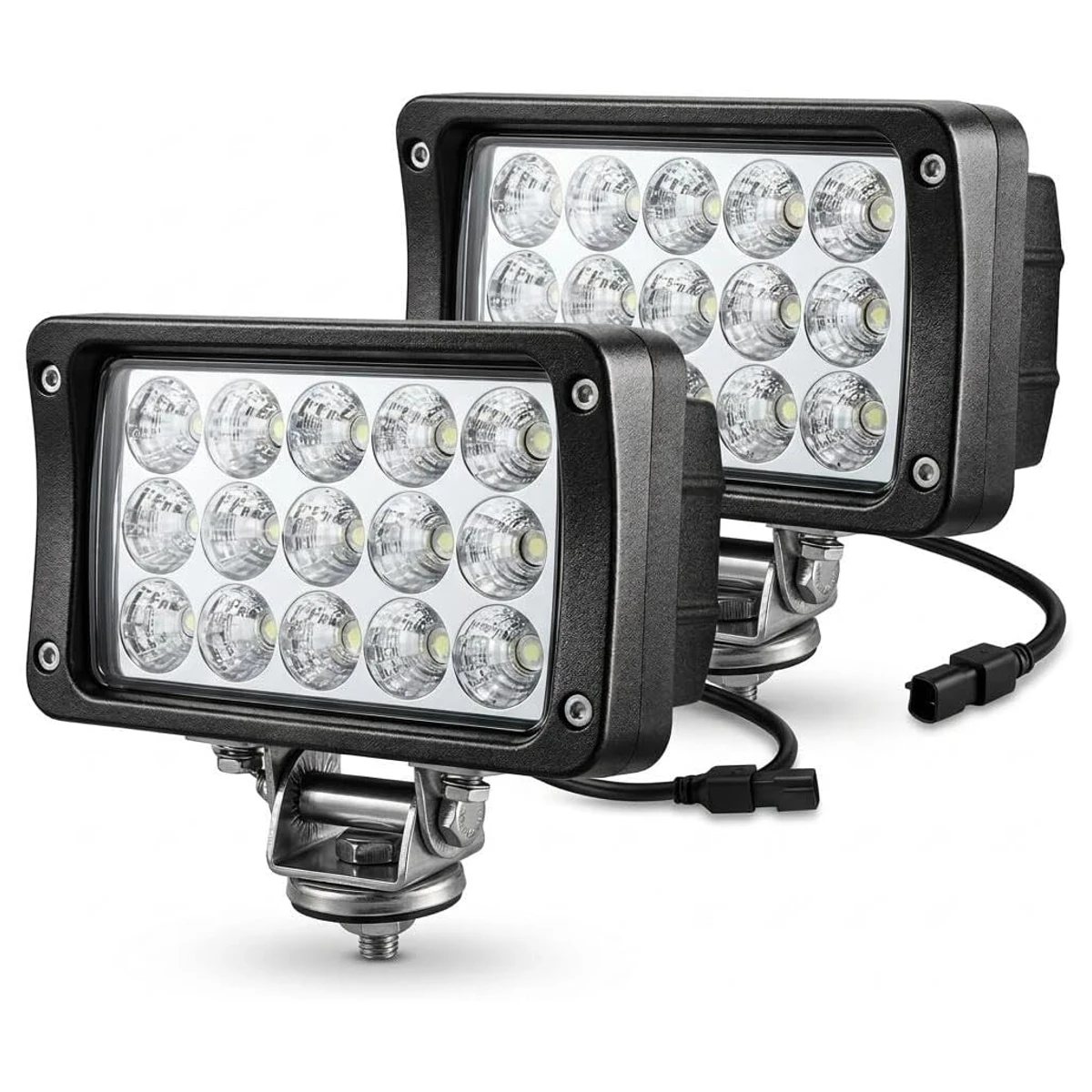
1. Watts: LED chip totals are not measured input power
A listing may add the nominal ratings of individual LED chips and present that total as lamp wattage. It does not establish what the finished lamp actually draws. Ask whether the quoted figure means LED component capacity or measured electrical input.
For a steady DC supply, input power is approximately voltage at the lamp × input current. Record both values, ambient temperature and the time after switch-on. Compare cold-start and thermally stabilised operation; a lamp may reduce output as it warms up. One current reading at an unspecified voltage cannot by itself prove a false claim.
Ask the supplier: “What are the stabilised input current and input power at our operating voltage, and what tolerance applies to production units?”
2. Lumens: ask what was actually measured
Calculated LED-chip lumens and measured output from the assembled lamp are different figures. Optics, lens losses, operating current and temperature affect the light leaving the finished product. Ask for the measurement method, test voltage, temperature and whether the value is initial or stabilised.
Lumens alone also cannot tell a mechanic whether the work area is usable. Ask for an illuminance map or lux readings at the relevant distance, with the beam and aiming stated. A broad flood can suit close work around an excavator; a longer-distance task may require a different distribution. Avoid comparing photographs taken with different camera exposure settings.
3. Voltage range: lighting up is not the same as continuous operation
A wide input-voltage label should describe a supported operating range, with any output or temperature limitations stated. Request evidence at the lower and upper limits, including start-up, current draw and sustained operation. Briefly illuminating a lamp at a voltage does not establish that it can work there continuously.
Vehicle electrical transients, reverse polarity and electromagnetic compatibility are separate questions. A “12V/24V” or wide-range label is not proof of load-dump protection or a particular approval. Specify the vehicle supply and ask for documents covering the exact model and version.
4. Same appearance, different materials and heat paths
Do not assume an identical front view means identical construction. Confirm the housing material separately from the lens: a polycarbonate lens does not mean the whole lamp has a plastic housing.
An aluminium housing can help transfer heat, but alloy, wall thickness, internal thermal contact and fin design still matter. An engineered plastic housing can also be appropriate when the thermal design supports the required output. Neither material name is a substitute for stabilised performance and durability evidence.
Check installation clearance and whether mud can obstruct the cooling surfaces. A lamp tested in open air may experience different temperatures beside an engine, under a crowded guard or after a shift in dusty conditions.
5. Higher power needs a matched wiring system
As an illustration, a lamp drawing 120W of electrical input would draw approximately 10A at 12V or 5A at 24V in steady operation. These are explanatory figures, not installation or fuse-sizing instructions; start-up behaviour and the real supply conditions also matter.
A qualified installer should select the cable, fuse, relay and connectors together, considering measured current, the complete outgoing-and-return cable length, voltage drop, ambient temperature, cable bundling and contact ratings. The protective device must suit the circuit and wiring, rather than being chosen only from the lamp label.
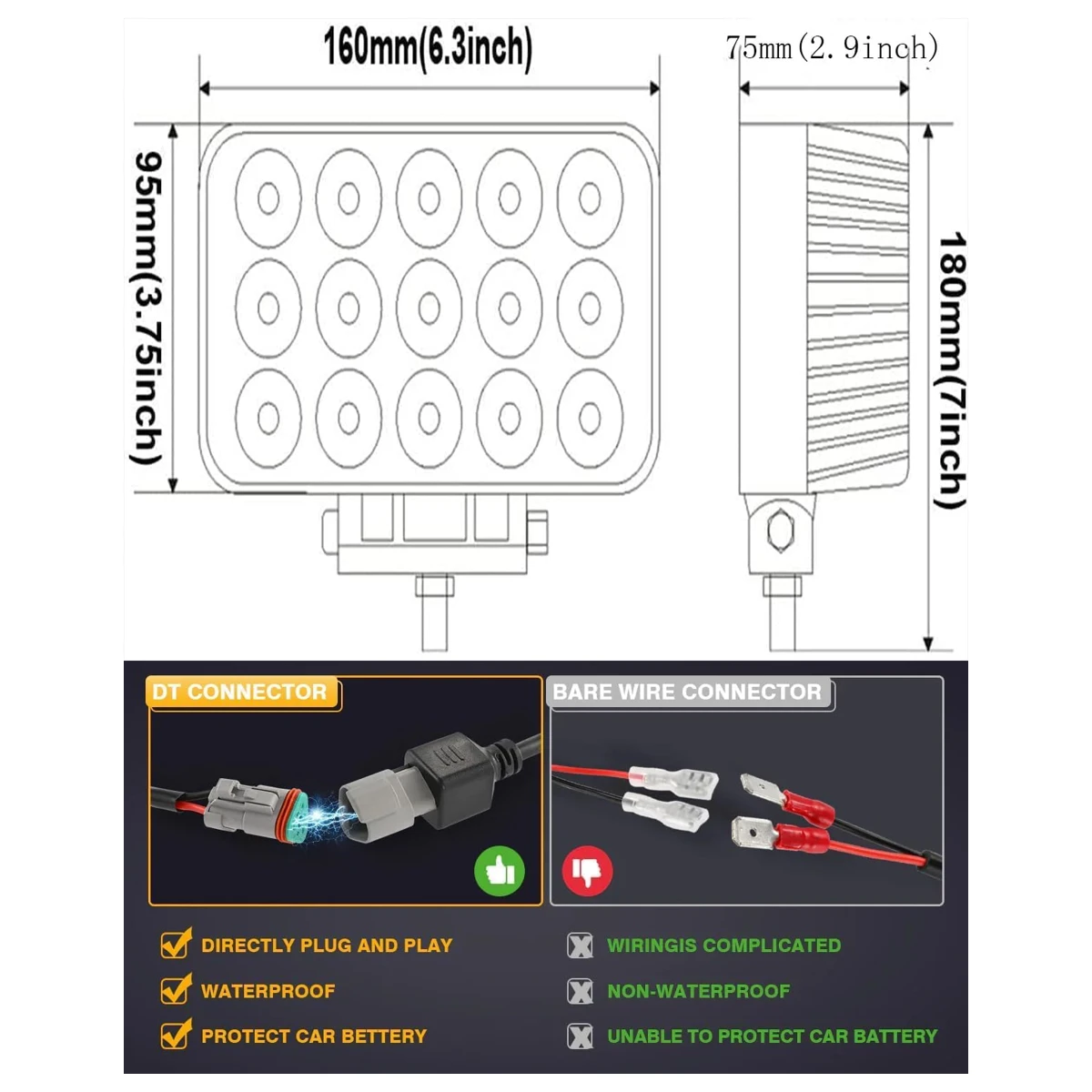
Confirm the actual connector manufacturer, contact system, seal, wire-size range and installation requirements. A connector that looks like a familiar type does not automatically have the same current rating or make a lamp a direct replacement.
6. Harsh environments: inspect brackets, fasteners and seals
In a quarry or mine, the bracket and wiring can be as important as the LEDs. Specify vibration and shock exposure, mounting position, washing practices, dust, moisture and likely chemical contact. Inspect bracket rigidity, adjustment retention, fastener specification, cable support and connector strain relief.
For salt exposure, request the bracket material or grade, coating system, fasteners and corrosion-test report with its acceptance criteria. Include welds, cut edges and interfaces between different metals in the discussion. A water-ingress rating does not establish corrosion or vibration resistance.
“Acid resistant” needs a defined chemical exposure. Identify the substance, concentration, temperature and contact time before selecting materials. A neutral salt-spray report does not prove resistance to every acidic environment. ISO 9227 describes salt-spray methods; it does not assign a universal product pass time or predict years of field life. Ask what was tested and how the result was judged.
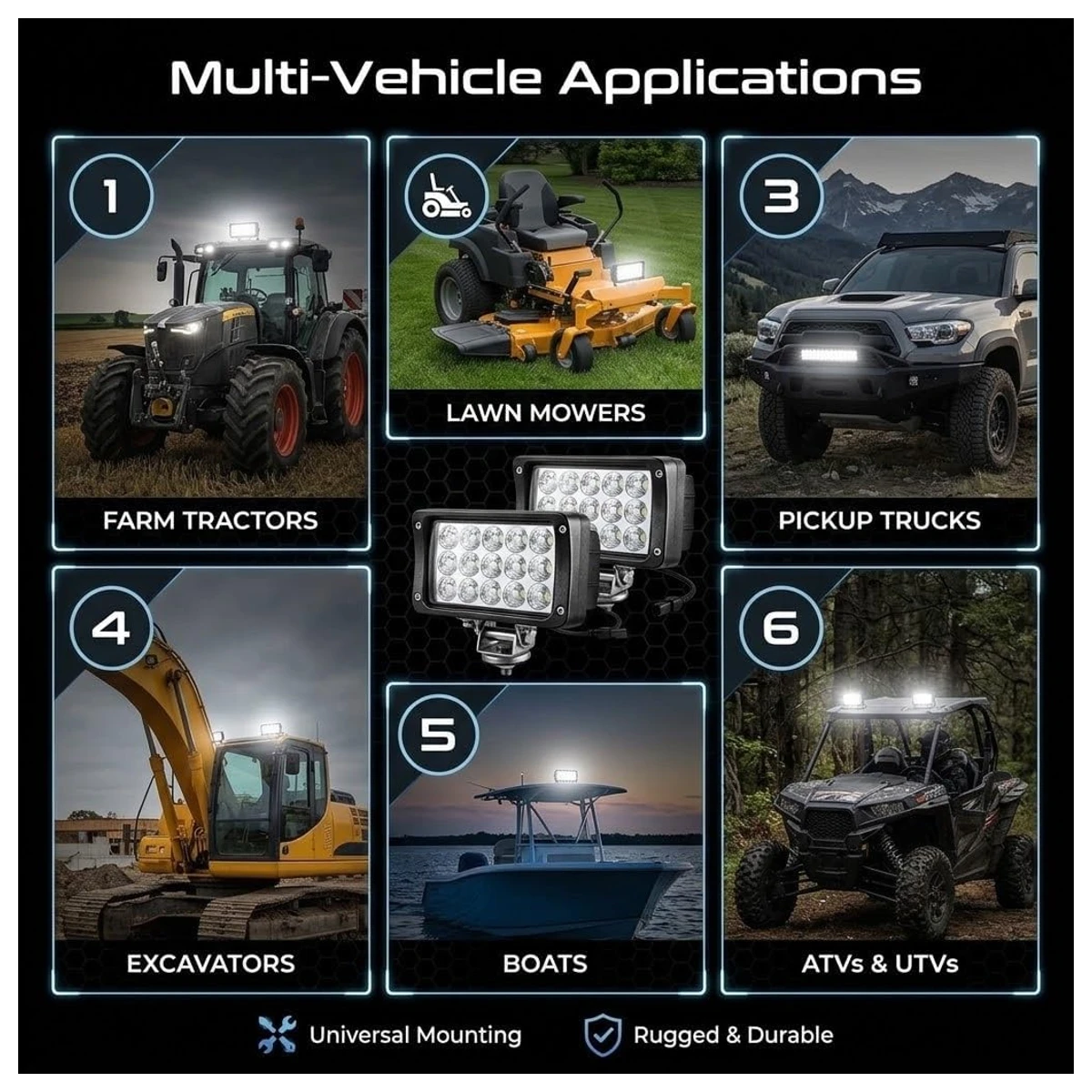
Application example: an excavator on a night shift
Start with the task: does the operator need close-range coverage of the bucket and track area, side visibility for maintenance, or illumination farther away? Assess shadows, reflections and glare toward colleagues. Select beam distribution and aiming before increasing wattage.
For a mining or quarry vehicle, add continuous shift duration, mounting vibration, dust accumulation and cleaning chemicals to the RFQ. Validate a sample in the intended installation before committing to a fleet or stocking order. An application image helps describe the task; it does not prove a model has passed that site’s requirements.
A purchasing checklist for wholesalers and repair businesses
| Compare | Request before approval |
|---|---|
| Electrical input | Measured voltage, stabilised current, input power and tolerance |
| Useful light | Measured finished-lamp lumens; beam and lux at the working distance |
| Operating range | Continuous-operation conditions and separate protection evidence |
| Construction | Housing, lens, thermal path, seals and exact product version |
| Installation | Dimensions, bracket, connector, mating parts and wiring requirements |
| Environment | Relevant ingress, vibration and corrosion tests with criteria |
| Batch consistency | Approved sample, agreed bill of materials and change-control process |
Keep an approved reference sample, specification revision and accessory list. Agree how material or component substitutions must be approved. This gives your purchasing and service teams a clearer basis for incoming inspection and warranty discussions.
Frequently asked questions
Is the highest-wattage work light always the best choice?
No. Choose the usable beam, sustained output and installation compatibility needed for the task. More input power can also increase demands on cooling and wiring.
Can two lamps with the same housing have different quality?
Yes. Drivers, thermal interfaces, seals, cable construction and bracket materials can differ. Compare the exact configuration and supporting evidence.
Does a salt-spray test prove a bracket will last a certain number of years?
No. Test conditions and acceptance criteria matter, and accelerated test hours should not be converted directly into years of service.
What should I send EVEREST for a recommendation?
Send the vehicle or machine, supply voltage, task and working distance, shift duration, mounting space, connector details, dust/water/salt/chemical exposure, destination market and estimated order quantity.
Build the specification around your customer’s work
EVEREST can discuss suitable work-light options for your application and confirm the specifications and available documents for the proposed model and configuration. For example, EV-AW018 is listed with a rectangular flood beam, 9–30V DC input, an aluminium housing, PC lens and DT connector. Suitability for a specific mine, vehicle or chemical environment still needs confirmation.
Importing, stocking replacement lamps or maintaining a fleet? Send EVEREST your operating conditions and purchasing requirements, or email sales@everestled.com. Ask for a targeted recommendation and agree sample checks before ordering.
Related reading: Choosing work-light beams and fitment · Comparing LED lighting quotations.
Technical references
HELLA: work lamps, light output and thermal management · ISO 9227: salt-spray test scope and limitations · TE Connectivity: connector-specific DEUTSCH DT information.